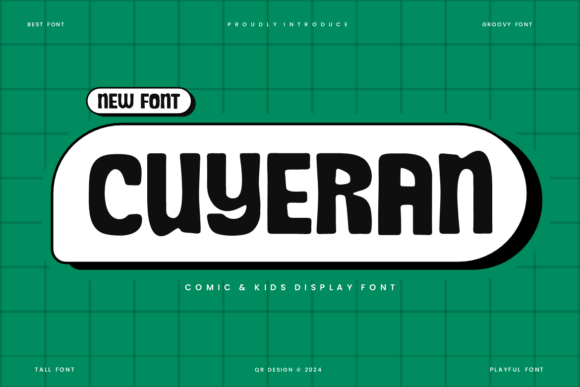
Cuyeran Font: Bold, Authentic Display Type for Handmade Brands
If you’ve ever spent hours tweaking a label design only to realize the font lacks presence—or printed a sticker that looked weak at 3/8 inch tall—you know how much hinges on the right display font. That’s why I reached for Cuyeran the moment I saw it: a bold, authentic display font with grounded weight and quiet confidence. It doesn’t shout—it commands attention with clarity and craft. As someone who designs printable planner pages, cuts vinyl for boutique tags, and hand-presses greeting cards for local makers, I need typefaces that hold up across materials, sizes, and uses—and Cuyeran delivers without compromise.
Cuyeran’s visual personality sits beautifully between rustic charm and modern polish. Its letterforms are sturdy but not rigid—think clean terminals, balanced contrast, and open counters that breathe even in tight spaces. It’s not a script, not a serif, not a minimalist sans—it’s its own kind of display font: expressive yet legible, distinctive yet versatile. That authenticity shines through on physical products: a farmhouse-style welcome sign cut from birch plywood, a small kraft paper tag tied to a handmade soap bar, or a foil-stamped wedding invitation suite. Customers don’t just read the words—they feel the care behind them.
For crafters using Cricut, Silhouette, or manual cutting tools, readability is non-negotiable. Cuyeran scales down cleanly to 10–12 pt for product labels (like candle jars or spice tins) and holds crisp edges at 16–24 pt for stickers, wall art prints, and digital templates. I tested it at 8 pt on matte vinyl—still fully legible when held at arm’s length. No fuzzy joins, no collapsed details. And because it’s designed as a display font—not body text—it thrives in short phrases: shop names, seasonal slogans (“Hand-Poured • Small Batch”), event titles (“The Maplewood Wedding”), or product descriptors (“Small-Batch Lavender Honey”). Avoid using it for full paragraphs, but lean into its strength: impact, identity, and intention.
In my own shop, I’ve used Cuyeran across six very different product lines—and each time, it reinforced brand cohesion. On soy wax candle labels, it pairs with a delicate handwritten font for “Scent Name” (like Coastal Fog) while Cuyeran anchors the brand name in bold, centered caps. For printable baby shower invitations, I layered it over soft watercolor textures—its weight grounds the design without overwhelming the whimsy. On laser-cut wooden signs for garden sheds and coffee shops, Cuyeran’s clean outlines cut precisely every time, with no chipping or bridging issues. Even holiday packaging—think kraft mailer boxes stamped with “Joy • Gather • Give”—feels intentional and elevated thanks to Cuyeran’s confident rhythm.
Font pairing is where Cuyeran truly shines in practice. Because it’s a strong display font, it works best with quieter companions. Try it alongside a relaxed script font for names or accents—something with natural flow, not excessive swashes—so the two don’t compete. Or pair it with a clean, neutral sans serif (like Montserrat or Lato) for supporting text on product tags, business cards, or digital printables. For wedding stationery, I often use Cuyeran for the couple’s names and venue title, then switch to a warm serif like Playfair Display for date, time, and RSVP details. The contrast creates hierarchy without clutter. Just remember: if your project includes alternates, ligatures, or stylistic sets (check the Cuyeran file package), test them early—especially for SVG designs or layered mockups where overlapping characters can cause rendering hiccups.
Practically speaking, Cuyeran comes in standard OTF and TTF formats—fully compatible with Canva, Adobe Creative Cloud, Cricut Design Space, Silhouette Studio, and most cutting machines. It supports basic Latin multilingual characters (including accented letters common in French, Spanish, and German), which matters if you sell internationally or design bilingual baby announcements or boutique packaging. While it doesn’t include extended language support like Cyrillic or Arabic, its core character set covers 95% of everyday craft needs—from “Made in USA” tags to “Merci Beaucoup” gift cards.
Licensing is where many creators pause—and rightly so. Cuyeran is a commercial font, meaning it’s cleared for use in physical products you sell (stickers, mugs, tote bags), digital downloads (printable planners, Canva templates), client work (logo design, shop branding), and SVG files for cutting machines. You do not need an extended license to sell items featuring Cuyeran—but always verify the license terms included with your purchase. Some sellers mistakenly assume “personal use only” applies to all fonts; Cuyeran isn’t one of them. That said, you may not resell or redistribute the font files themselves, embed them in unsecured web apps, or claim authorship. Keep it simple: you’re licensing usage rights, not ownership—and that’s exactly what lets you build real, scalable value around your handmade brand.
What makes Cuyeran more than just another display font is how it bridges intention and execution. It looks handmade without looking amateurish. It feels premium without feeling cold. Whether you're pressing foil onto wedding menus, printing tea towel patterns, or designing Instagram story templates for fellow sellers, Cuyeran adds quiet authority. It tells customers, “This was made with thought—not just speed.” And in a market crowded with generic fonts and AI-generated fluff, that distinction isn’t subtle. It’s your signature, carved in type.